War of the Worlds 2.0

Kris Kowal; friend, former Apple coworker, and JavaScript god; has taken the ideas in my previous Twitter Fiction entry and the (much-earlier) work of Ars Technica’s Ryan Paul and he has written up a plan. You must read this plan.

It sounds to me like Halloween on Twitter is going to be a blast this year! Will you join in?

I find the fact that this is an unplanned, unfocused story to be quite apropos to Twitter, actually. The story probably isn’t so much in the narrative itself as it is in the creativity of the participating individuals. That’s really the heart of “2.0.” Thank you, Kris!

Twitter Fiction

There have already been several different attempts to bring fiction writing to Twitter. A couple come to mind:

  • 140novel: An attempt by Leo Laporte and the hosts of the Buzz Out Loud podcast to collaboratively write a work of fiction 140 characters at a time, apparently without knowing where the story was going beforehand. Obviously it only lasted two months and 36 tweets, but it was an interesting idea.
  • twitterfiction: Tiny works of fiction in each tweet. There’s no central story here, each tweet is separate from the others. User submissions are accepted. This one only lasted about two weeks and 35 tweets.

I have a new idea which I think is far more realistic and also a lot more interesting than these. One of the key elements of Twitter that the two ideas above don’t take into account is the real-time nature of Twitter. We’re all familiar with stories told in real-time or near real-time like the TV show 24. Why not try this on Twitter? Of course the core of the story would be text, but Twitter easily supports pictures, taken on cellphones for instance, that can be published instantly. Video could be done in a similar way if desired. 

You could take it a step further and have a multi-character story where each character gives a first-person account of the story in real time, all simultaneously. The chance for a complex, intense narrative is really amazing here. Perhaps some of the characters would be on Twitter (with photos and video where appropriate) and others off Twitter and only referred to by those we’re reading, and we’d be left to piece together the full narrative J. J. Abrams-style.

The story would be an event, live, happening right then and there on Twitter, just like the debates or other nationwide happenings. The author could just say, “My next story will begin on November 3rd at 7pm. I will announce the initial characters you must follow on November 3rd at 3pm. This story will take two hours.” If desired, the characters could then reveal more Twitter characters in their tweets as the story progressed, and your cast of characters could grow. As I’ve already hinted, I think this format would work best for fairly short stories and happenings. It seems to me that anything over a few hours long approaches a breaking point and forces the reader to break their immersion during the story. I wouldn’t want to watch a story in real-time over six months unless it was specially-written and appropriate to that kind of timeframe.

Another aspect of Twitter that could be brought into this particular fiction medium is that of the ARG, or alternate reality game. I’m not aware of anyone using Twitter for an ARG, but it seems so obvious that I would guess it has already happened multiple times. If the writer chose to incorporate ARG elements, the Twitter characters could actually respond to readers as the story happened, interacting with them, calling them on the phone or receiving phone calls from them, and encouraging people with whom they were communicating to also relay messages to the rest of the community, thus pulling chosen Twitter users into the fiction and making them part of the story. I suppose at some point in the story readers wouldn’t be able to tell which participants were normal Twitter users and which were planted actors and actresses playing fictional characters. But that’s part of the ARG idea. It enhances the story and makes it far more real, and thus more fun.

Clearly, even a fairly simple story with no ARG elements that was an hour or two long would require a talented writer and a small team of people to pull off, especially if it incorporated multimedia and more than one character. No one said great art is easy. Making history isn’t easy either.

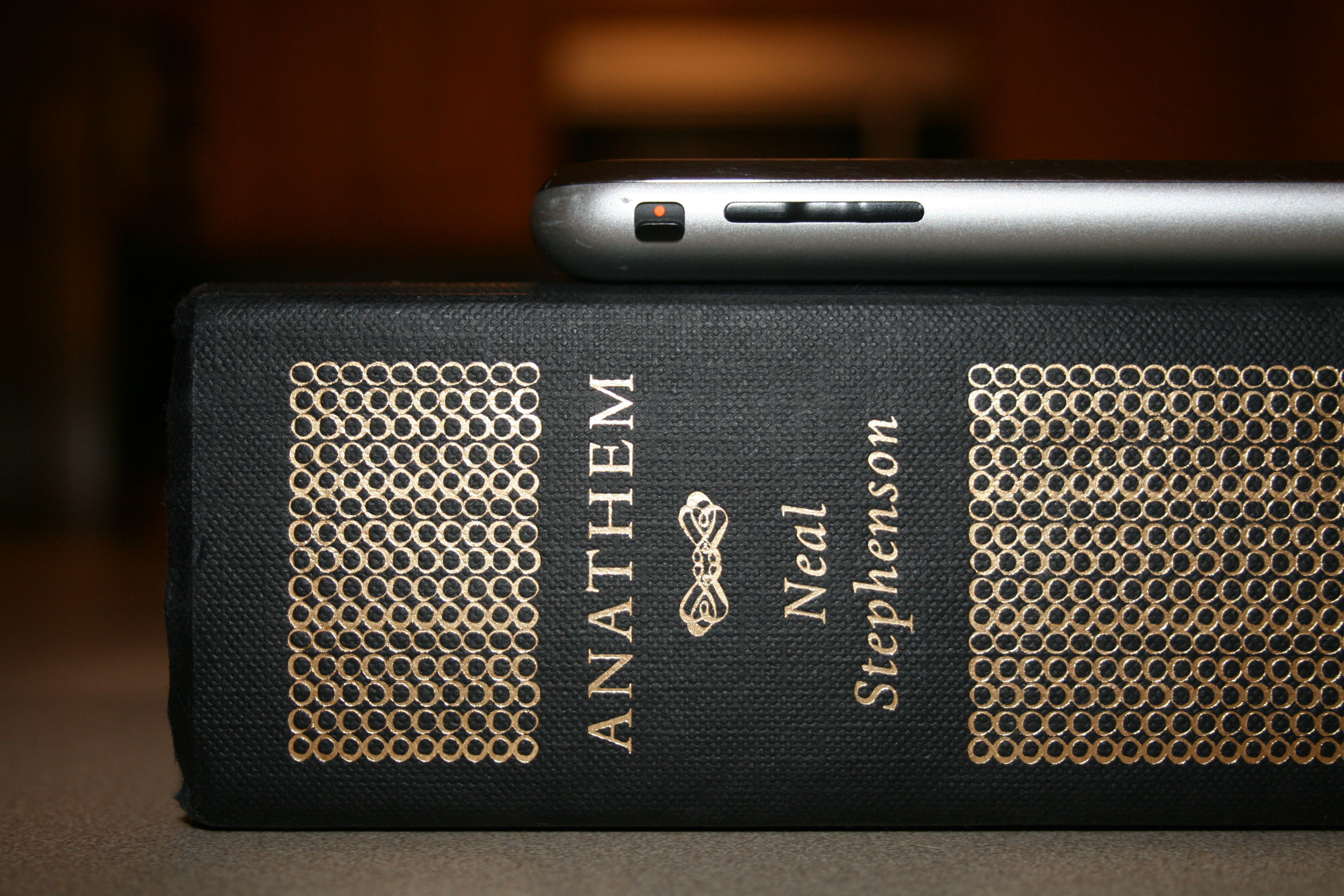
My iPhone on Anathem, and Vice Versa

Anathem and the iPhone

Tonight I decided to try reading a full-length book on my iPhone. I was about 20% of the way through Anathem, so I decided I would just continue it on the iPhone. I happened to have a 50% discount code in an email, so I bought the eReader version for $9.

So far, I’m really enjoying the experience. We’ll see how I feel when I’m done with the book, but I’m coming to understand that the iPhone and iPod Touch can now have the same shrinking effect on book libraries as the iPod has had on all our CD libraries. This may not have quite as big an effect on our personal lives as the iPod did since people tend to only read a small number of books simultaneously, but then again, no one used to carry 200 CDs worth of music with them everywhere either. Now, it seems every other pedestrian I pass on my way from the bus to the office has little white earbuds stuffed in their ears.

I’m not sure why, but in spite of the fact that I’ve seen this all before, I’m still amazed by the size contrast. Look at that photo. Anathem has been painful to shove in my backpack every day. It’s bigger than most Bibles. Anathem is about 900 pages long. Now it’s in my pocket and the font size hasn’t gotten any smaller.

I admit the Kindle has some advantages on the iPhone. More words per screen at the same font size would be one. The Kindle definitely doesn’t have a higher contrast ratio, text-to-background. I think the iPhone / iPod Touch’s biggest advantage is that it’s already in my pocket, thus making Anathem and all the other books I might purchase for the iPhone some day effectively weightless. It’s tough to beat that.

Twitter and the Debate

Tonight’s presidential debate between McCain and Obama began about 50 minutes ago. Steph and I don’t have cable TV, and our reception is pretty bad out here, so I haven’t been watching the actual debate itself on TV. (If you’re curious, we get all our TV from various reputable locations the Net.) I have, however, been watching the comments going by on Twitter’s Election 2008 site.

If you go there outside the debate, you’ll of course see all the random things people are saying about the candidates, the election, and other buzzwords surrounding their campaigns. But visiting the site during the debate itself is an interesting and unique experience. Being able to watch people’s reactions live (or nearly-live, perhaps delayed by a minute or two) is a fascinating, unfiltered look into what Americans are thinking as the event happens moment by moment. All the funny lines, all the stutters, and a lot of overflowing love and disagreement are tangled up in the stream as you watch it go past. It’s beautiful.

It felt like a pretty important moment at the intersection of politics, technology, and public discourse, so I recorded a movie of it scrolling by on my screen about 20 minutes after the debates started, just to give a sense of what it was like. It’s just under four minutes long. Note that the language and emotions are unfiltered, as I have already said, and with that in mind, check it out.